
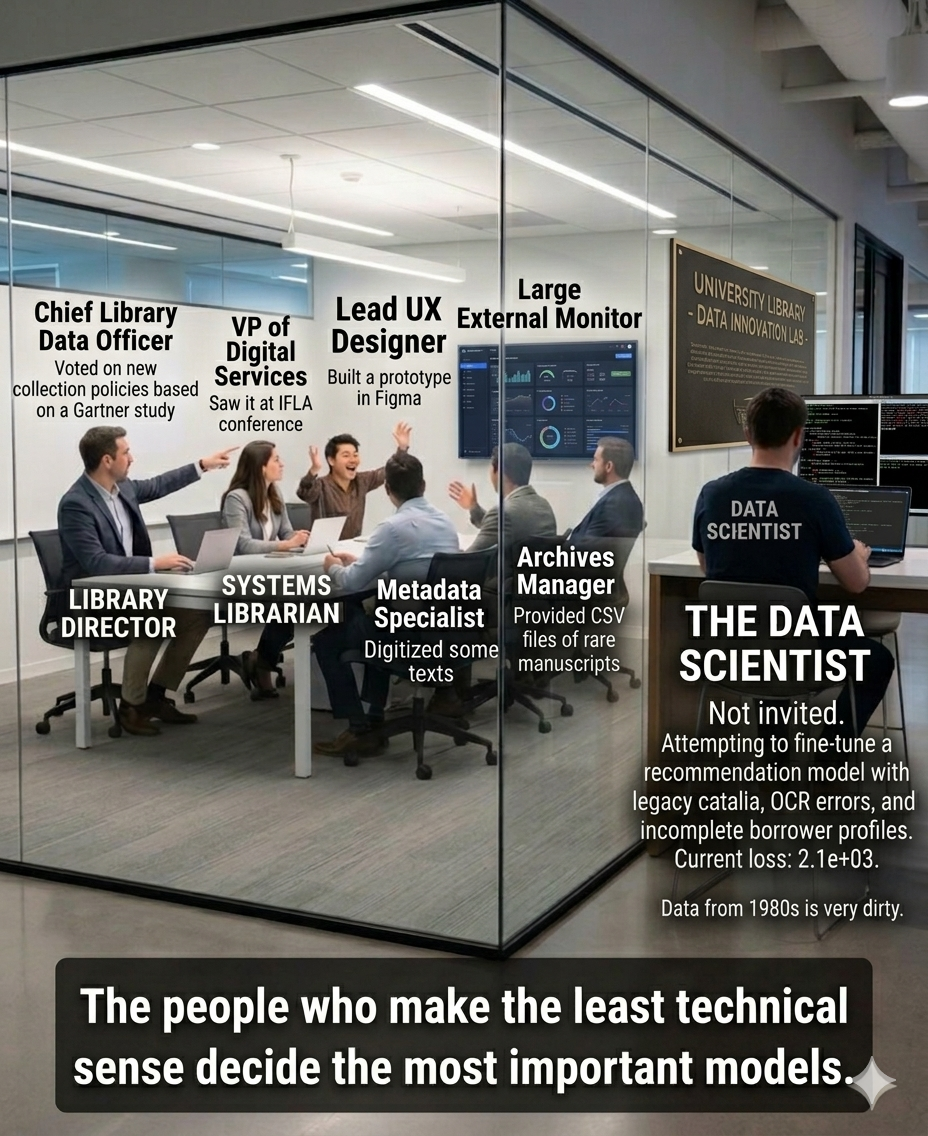
In a glass-walled meeting room, a group of decision-makers enthusiastically discusses the future of a library. Titles signal authority and innovation: Chief Library Data Officer, VP of Digital Services, Lead UX Designer. Ideas move quickly—new collection strategies inspired by international conferences, prototypes built in Figma, and dashboards filled with sleek visualizations. It is a scene that feels familiar in today’s digitally ambitious institutions.
Just outside that room, however, sits another figure: the data scientist. Not invited. Not consulted. Yet quietly attempting to make sense of the very data upon which those strategic decisions depend.
The Illusion of Data Readiness
Libraries are increasingly expected to operate as data-driven organizations. From collection development and circulation analysis to digital services and user engagement, data is now seen as essential for planning, evaluation, and policy justification. On paper, this signals progress. It suggests that libraries are moving toward evidence-based governance and more intelligent decision-making.
But beneath that aspiration lies a more difficult truth: library data is rarely clean, complete, or immediately ready for analysis. It is often scattered across legacy systems, shaped by different cataloging traditions, and burdened by decades of inconsistent practices. Metadata fields may not align across platforms. OCR-generated text may contain serious errors. Borrower profiles can be incomplete. Historical records are frequently digitized but not standardized.
In this environment, the assumption that data is readily available for artificial intelligence, advanced analytics, or predictive modeling is often misleading. What appears to be a technical asset may, in reality, be a deeply fragile foundation.
The Data Scientist’s Paradox
The data scientist in a library occupies a paradoxical role. Institutions often expect sophisticated outputs—recommendation systems, predictive insights, automated classification, service optimization—yet the first and most difficult task is usually much more basic: making the data usable.
Before any model can be meaningfully developed, the data scientist often has to:
- reconstruct fragmented datasets from multiple systems and reporting environments;
- resolve inconsistencies in metadata schemas and field definitions;
- identify missing values, duplicates, and contradictory records;
- interpret historical data whose original operational context may no longer be documented.
In other words, the work is not only about model building. It is about restoring coherence to an information environment that has evolved over many years without a single analytical design in mind. Much of this labor is invisible, yet it determines whether any subsequent analysis is credible.
When Decisions Outpace Understanding
The image that inspires this reflection captures an important organizational tension. Decisions about technically complex systems are often made by those who do not directly confront the underlying data challenges. This is not necessarily because leadership lacks intelligence or commitment. Rather, it reflects a structural separation between strategy and data reality.
Meetings tend to focus on outputs: dashboards, digital innovation, AI services, and new user-facing systems. These are visible, communicable, and politically attractive. What receives less attention is the long, painstaking effort required to ensure that the underlying data is reliable enough to support those ambitions. As a result, institutions may deploy models on unstable foundations, generate misleading insights, or make policy decisions that look evidence-based but rest on compromised information.
The real challenge in data-driven libraries is not merely producing analytics. It is ensuring that the analytics are built on data that genuinely reflects reality.
The Real Role of the Data Scientist in Libraries
In this context, the data scientist’s role extends far beyond algorithm development. Their work is fundamentally interpretive, translational, and corrective. They transform raw, heterogeneous data into forms that can be analyzed. They validate whether the data is fit for purpose. They explain the limitations of the evidence. They bridge the gap between technical processes and managerial understanding.
In libraries, this role is especially important because data rarely speaks for itself. Numbers must be contextualized within the realities of cataloging workflows, collection histories, service patterns, user demographics, and institutional reporting systems. A circulation trend, for example, may reflect not only user demand but also cataloging changes, digitization backlogs, or inconsistent borrower registration practices. Without that contextual knowledge, even accurate models can be misinterpreted.
From Model-Centric to Data-Centric Thinking
One of the most important lessons for libraries is the need to move from model-centric thinking to data-centric thinking. Organizations often become captivated by what models can do. They imagine recommendation engines, automated summaries, predictive indicators, and intelligent dashboards. Yet the performance of any model depends entirely on the quality, structure, and representativeness of the data behind it.
Without a strong data foundation, even the most sophisticated model will produce outputs that are difficult to trust. The issue is not whether the algorithm is advanced enough, but whether the institution has invested sufficiently in data integration, governance, cleaning, and documentation. A model cannot compensate for poorly understood data. It can only amplify the weaknesses embedded within it.
Repositioning the Data Scientist
If libraries want to fully benefit from data-driven decision-making, the data scientist cannot remain at the edge of strategic conversations. They must be integrated much earlier into project design and institutional planning. Their expertise should shape not only how models are built, but also how projects are scoped, what claims are considered valid, and what risks are acknowledged from the start.
This requires a cultural shift. It means recognizing that data preparation is not a secondary technical step, but a central component of digital transformation itself. It means understanding that a visually impressive dashboard is not the same as analytical maturity. Most importantly, it means accepting that evidence-based decision-making begins long before a chart is displayed or a model is deployed.
Conclusion
The image presents a simple but powerful message: the people least involved in technical data work often shape the decisions that matter most. In libraries, this disconnect can have serious consequences. It can produce systems that appear innovative while masking underlying fragility. It can encourage premature confidence in analytics that are not yet reliable. And it can sideline the very professionals best positioned to protect the integrity of data-driven work.
The data scientist in a library is not merely a model builder. They are a steward of analytical credibility. Their work ensures that data reflects operational reality, that patterns are interpreted responsibly, and that innovation is grounded in evidence rather than appearance.
In the end, the success of a data-driven library is not determined by how advanced its models appear, but by how honestly and rigorously it confronts the condition of its data. That is why the data scientist—often unseen, often excluded, but always essential—deserves a far more central place in the future of library innovation.